

Hello, and welcome to this week’s episode of PerthshireHour. This episode will look at some of Perthshire’s hidden histories, including unusual buildings and landmarks, and forgotten stories from the past. To listen to this week’s episode (and all previous episodes) simply click here.
Earthquake House
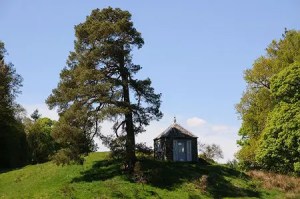 Comrie lies seven miles West of Crieff and is occasionally known by another name: ‘The Shakey Toon’. It’s a name that takes a little explaining.
Comrie’s is probably best known for local attractions such as Auchingarrich Wildlife Park, Comrie Croft (mountain bike tracks/ wedding venue/ and campground), and the array of artists, artisans, and other creative folks who work out at Cultybraggan.
However, Comrie also happens to be known as the ‘earthquake capital of the UK’ with more earthquakes than any other part of the British Isles.
Comrie’s ‘earthquake house’ was erected in 1874 with this in mind and since then it has been used as a base to observe this odd phenomenon.
The sensory equipment has obviously seen a few updates since then but Earthquake House is still very much in use by the British Geological Survey today. You can click this link for more information about ‘Earthquake House’.
Romans and Picts in Dunning
Next in tonight’s episode, we journey to the town of Dunning in Perthshire, to explore its fascinating past as a meeting point for Romans and Picts.
As you travel north along the A9, we encounter the Findo Gask Ridge. It’s less of a notable structure now and might seem more like an earthen mound. However, it once formed part of the Roman defensive and observation line from the first century AD.
There, you’ll also find the remains of Muir O’Fauld, a Roman watchtower. This tower was one of the eighteen fortlets and watchtowers that connected larger forts across Perthshire. While it dates back to AD 79 to AD 86, it’s still accessible today, offering a glimpse into Roman history in the area.
Along at St. Serf’s Church in Dunning (which was mentioned in a charter from 1219), there appears to be the remains of a structure associated with the cult of St. Serf (which dates it much further back, to AD500).
Dunning Church (which is now a museum and visitor attraction), houses the remarkable Dupplin Cross, a symbol of Pictish heritage. Dating back to around AD 800, this sandstone cross was created for King Constantine, who ruled from AD 789 to AD 820. Standing at an impressive 9.5 feet, it is the only surviving complete, free-standing cross from the Pictish region. Its relocation to Dunning Church ensures its preservation and allows visitors to appreciate its historical significance.
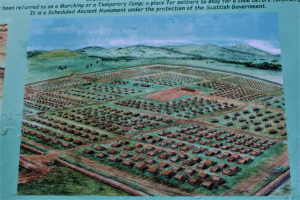 Also worth noting is the Roman rampart in Kincladie Wood, just north of Dunning. The Roman Marching Camp is located about half a mile outside Dunning on the left of the B935 road to Forteviot. This took the form of a short-term camp enclosed in a shallow ditch and palisade constructed by Roman troops. This camp is sometimes postulated as the site of the famous ‘Battle of Mons Graupius’ (AD 83 or AD 84). This battle saw a Roman force of up to 30,000 men go up against an equal number on the Caledonian (Pictish) side (though it’s hard to verify numbers in battles from such an ancient time).
What we do know is that Picts and Romans would have spent a fair bit of time in proximity to one another. Likely coming to blows, skirmishes, and all-out battles in what is now the site of a lovely wee country village in the middle of southern Perthshire.
I got my information regarding Dunning’s surprisingly busy (and possibly brutal) past at Nigel Cole’s website. You’ll find a link to Nigel’s website here.
Crieff Cursus
Back in 2012, an unbelievably unusual discovery was made in Crieff. During routine excavations as part of works for the Beauly to Denny powerline evidence of a ‘Cursus’ was found. This led to more thorough dig, and the unveiling of more features of a 3000-year-old site, described by Alan Leslie, director of Northlight Heritage as “… basically the start of Crieff…”
A cursus is a mysterious and massive structure or series of structures which many historians suspect played some religious role in the lives of those who built it.
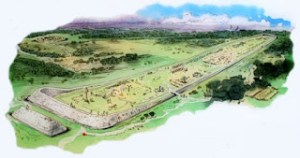 A cursus is a long, narrow, rectangular enclosure, made of earth mounds. A cursus found in Arran appears to have been as much as a kilometre long. Crieff’s wasn’t quite so big but was definitely large by building standards in the area three-thousand years ago.
A cursus also typically has limited ways in and out and it’s even suggested that only certain individuals would have been allowed into the cursus to walk within its earthen walls
In our cursus in Crieff (as with many Scottish examples of these structures) they also found evidence of post-holes which would have held large upright timbers. It’s likely that these timbers also made up part of the perimeter.
The reason for the structure of the cursus, and the uses that Crieff’s early inhabitants put it to are still up for debate. However, there’s little doubt that it’s fun to imagine what they might have done with it.
You can actually ponder the uses yourself down at the Strathearn Community Campus where you’ll see a recreation of one of the upright timber structures as it would have appeared in the same area millennia ago.
For more information about the cursus (and heaps of other local history), you can visit Colin Mayall’s history blog here.
Upcoming Episodes
A bit of housekeeping. The themes of the podcast vary weekly and the following topics cover the next two weeks of episodes. If either of these topics sound like something relevant to you please get in touch and we’ll get you featured in the episode (don’t worry, you don’t have to send in a recording if you’d rather simply share some text).
Wednesday the 21st of June: The Role of Perthshire Businesses in Supporting the Local Community
This episode will feature interviews with local business owners and leaders, discussing their commitment to supporting the local community and how they go about doing so.
Wednesday the 28th of June: The Creative Scene in Perthshire
This episode will showcase some of the most talented creatives in the area, including artists, musicians, writers, and designers, discussing their work, inspirations, and the challenges and advantages of working in a rural area.
Quick Mention (Fun for Kids in Muthill this Summer)
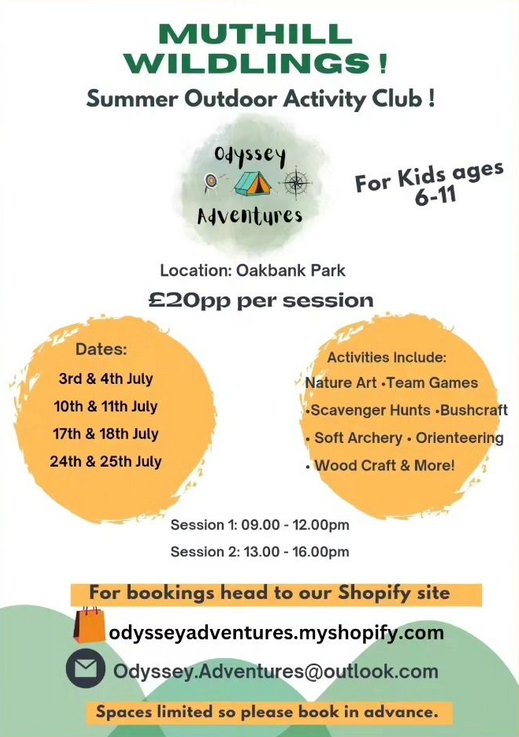 From Odyssey Adventures over on Instagram:
“Here it is!
Our first summer outdoor activity groups!
The Wildlings!
Looking for something fun for the kids to do during the holidays? Book onto our sessions via the link below and we’ll make sure they’re tired out from fun activities!
We have groups running in Oakbank and Muthill!”
More information can be found here on their Instagram Post.
Thanks for listening
Thanks as always for listening in to tonight’s episode and don’t forget to subscribe to the podcast using your favourite podcast provider. If you would like to be part of the PerthshireHour WhatsApp group please get in touch using this contact form. See you again next week,
All the best, John
 Green Flame Creative